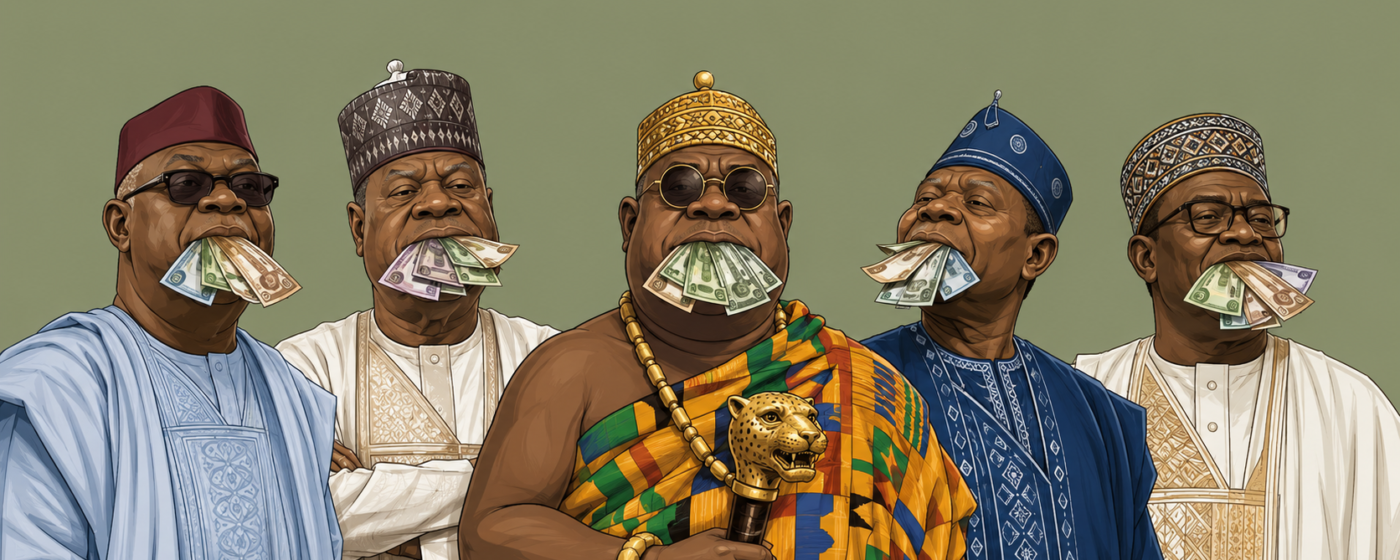
Paul Biya is 93 years old and has governed Cameroon since 1982. In October 2025, he supposedly won 53.66% of the vote in an election in which 70 out of 83 opposition candidate applications were rejected by the Electoral Commission. The man is older than most of his country’s institutions and has outlasted all credible challengers. Paul Biya’s story is not an anomaly peculiar to Cameroon; it reflects the broader system of leadership across the continent.
Across Africa, a recurring question haunts development economists, diaspora communities, and ordinary citizens alike: Why does the continent, so abundantly endowed with natural resources and human capital, keep producing leaders whose primary interest is self-preservation rather than nation-building? The answer is uncomfortable, and It has less to do with individual character than with the architecture of power; the incentives, institutions, and international arrangements that make plunder rational and patriotism optional.
The evidence of governance failure is not anecdotal. The 2024 Ibrahim Index of African Governance, covering the decade from 2014 to 2023, found that Africa’s overall governance progress ground to a halt in 2022 after four years of almost complete stagnation. About two-thirds of Africa’s population now experiences worse participation and accountability scores than it did a decade ago, while security- and democracy-related indicators have deteriorated for the vast majority of the continent’s people.
Out of a possible score of 100, overall governance stood at 49.3 in 2023, just one point higher than it had been a decade earlier. That represents ten years of elections, billions in donor aid, and countless inaugural speeches about transformation, producing only a single percentage point of measurable improvement. The continent is not merely standing still; in some respects, it appears to be sliding backwards, which is undoubtedly worrying.
Rigged Before the Ballots Are Cast
The problem begins well before election day. In much of Africa, the real contest for power takes place not among voters but within party structures dominated by what Nigerian political scientists call “political godfathers.” Candidate selection is controlled by elite networks, often resulting in the imposition of candidates. Parties function not on the basis of ideology or grassroots mobilisation but through clientelism and access to state resources. When the system selects candidates based on loyalty rather than competence, voters are left to choose among variations of the same product.
Electoral commissions, which are meant to referee the contest, are frequently captured by incumbents. The failure of many African countries to conduct credible elections and ensure peaceful transfers of power is a key driver of democratic regression across the region. It contributes to the shrinking of civic space and the weakening of critical democratic institutions, including the judiciary, legislature, and media. The judiciary and the media are supposed to serve as safeguards when elections fail, but when they are also compromised, citizens have no formal recourse. Some turn to the streets; others turn to the barracks.
The Coup That Looks Like Reform
Between 2020 and 2024, coups and attempted coups occurred in Burkina Faso, Gabon, Guinea, Guinea-Bissau, Mali, and Niger. Each junta initially presented itself as a corrective force, a response to corrupt civilian governments and predatory elections. In some cases, popular sentiment appeared to support this view. In Gabon’s April 2025 election, junta leader General Brice Oligui Nguema secured a landslide victory with 90.4% of the vote after altering the country’s transitional constitution to allow himself to run. The military had removed an autocrat only to install itself at the helm of affairs, thereby turning the ballot into a rubber stamp rather than a genuine reckoning with political performance.
This is the cruel logic of weak institutions: those who seize power to “fix” the system quickly discover that the system is more useful when it serves them. Patriotism, in this context, becomes a campaign slogan rather than a governing principle.
The Patronage Economy
Understanding why bad governance persists requires an understanding of who benefits from it. Elections in Africa are rarely truly free, and this is not simply because voters are uninformed. Rather, a significant proportion of the population is economically desperate. In Nigeria, constituency projects have degenerated into a slush pipeline, with anti-corruption agencies and civic monitors repeatedly uncovering inflated and fictitious projects worth billions of naira.
In the 2026 budget, Nigeria proposed an allocation of ₦8.05 billion for the construction, renovation, and equipping of places of worship. Tracka, a public accountability and civic technology organisation, revealed that ₦6.14 billion was budgeted for 52 mosques, while ₦1.91 billion was allocated to seven church projects, often concealed under ministries with no religious mandate. These questionable budgetary proposals were made against the backdrop of a nation burdened by high levels of poverty, insecurity, and youth unemployment.
The pre-election fiscal cycle now follows a systematic pattern during almost every election period. Governments expand spending, distribute cash, and make promises. However, after the ballots are counted, austerity often follows immediately, either because of heightened inflationary pressures or major policy changes introduced by the new government. Nigeria’s 2023 electoral cycle ended with the removal of fuel subsidies soon after the inauguration of the new administration, followed by a painful surge in inflation. In Zambia, the 2021 election was followed by an IMF programme and years of efforts to unwind arrears accumulated before the polls.
Voters, particularly those in rural areas with limited access to public services, often feel compelled to exchange their votes for immediate and tangible benefits, such as a bag of rice, a hospital visit, a school uniform for their children, or a small amount of money. Although many may perceive this behaviour as ignorance, it is often a rational response from people who have no social safety net and little confidence that the eventual winner will govern in their interests. This is especially evident in several parts of Nigeria, especially the northern region.
The Politics of Kinsmanship
Everyone likes to talk about how racism and profiling is prevalent in advanced economies and the western world, but discussions about tribalism and religious intolerance within the continent is often shied away from. Corruption and public fund embezzlement is often overlooked for a political candidate when the candidate in question belongs to the tribe or religion of the voter. In some scenarios, voters can go as far as advocating for the release of their tribal messiah (Politician) when the candidate is undergoing trials or investigation for criminal offenses. Politicians are very much aware of this sentimental virus and waste no time in taking advantage, they leverage the naivety of voters to spread tribalistic and religious incitements as a way to gain trust and votes. When the question of tribe and religion comes into play, Competence, credibility and capacity to lead slips out the window.
The Colonial Hangover and External Enablers
No honest analysis can ignore Africa’s structural inheritance from colonialism. Post-independence Africa experienced a wave of single-party states and military regimes that delayed the consolidation of democratic norms. Colonial administrators built extractive states specifically designed to siphon resources outward rather than deliver services to citizens. African leaders inherited this extractive machinery and, in many cases, merely redirected it for their personal benefit.
External actors have rarely helped. Western governments and international financial institutions have historically prioritised stability, access to markets, and security cooperation over democratic accountability. Weakened multilateral norms, divided international leadership, and intensified competition among great and middle powers have created a more permissive global environment in which external accountability has become secondary to transactional interests. China, the Gulf states, Russia, and Western countries compete for influence, yet none consistently makes electoral integrity a genuine condition for engagement.
Signs of Resistance
However flawed Africa’s leadership systems may be, the picture is not entirely bleak. The rise of Senegal’s Bassirou Diomaye Faye, following significant public unrest over attempts by the outgoing president to extend his tenure, demonstrated the strength of civic engagement. Similarly, Botswana’s October 2024 election ended the Botswana Democratic Party’s 58-year dominance, paving the way for a new era of leadership.
Growing youth-led mobilisations, particularly among members of Generation Z, have become central to safeguarding democratic resilience across Africa by reasserting civic agency amid institutional decline. Kenya’s 2024 Finance Bill protests, Nigeria’s End SARS protests, and Tanzania’s political upheaval in 2025 suggest that a new generation is unwilling to absorb the costs of elite rent-seeking in silence. Most Africans continue to express strong support for democratic governance, even as popular satisfaction with the performance of democracy steadily declines.
What Would Actually Change Things
The patriotism deficit across the continent should not be regarded as a cultural condition but as a consequence of institutional and incentive failure. Leaders who loot public resources are not necessarily morally different from those who serve; rather, they operate within systems that make looting safe and public service unnecessary. However, these dynamics could change if appropriate reforms were implemented.
A genuinely independent electoral commission with protected funding, a judiciary whose tenure is shielded from executive pressure, and transparent campaign-finance regulations could improve the quality of candidates presented to voters. Similarly, reducing donor and creditor tolerance for governance backsliding by making aid and access to finance contingent on measurable institutional benchmarks would increase the cost of autocracy.
Investment in civic education and a free press, although a long and often unglamorous process, would also help to build an informed electorate and weaken the conditions that make vote-buying effective. Most importantly, empowering citizens through employment, quality education, and accessible healthcare would improve living standards, reduce poverty through multiplier effects, and enable people to make more informed and rational choices when selecting their leaders.